
4 Ways To Reduce Weld Spatter
Spatter is one of the most common frustrations in welding. Those little bb’s of molten metal land on your workpiece, stick to your nozzle, and leave you with extra grinding and cleanup before a part can ship or be painted. Some spatter is normal, especially with MIG welding, but excessive spatter usually points to a problem you can fix. Here are four practical ways to keep spatter at a minimum.
Dial in Your Welding Parameters
The most common cause of heavy spatter is a poor balance between voltage and wire feed speed. If the voltage is too low for the wire feed speed, the wire stubs into the base metal and throws off spatter. If it’s too high, the arc becomes unstable and erratic.
Start with the settings recommended by your wire or machine manufacturer for your material thickness, then fine tune. A smooth, steady crackle, often compared to the sound of bacon frying, is a good sign. A harsh, popping sound usually means something is off.
Technique matters here too. Keep your contact tip to work distance (stickout) consistent, usually around 3/8 to 1/2 inch for MIG. Hold a gun angle of roughly 10 to 15 degrees, and avoid dragging too steeply, which can disturb the weld pool and increase spatter.
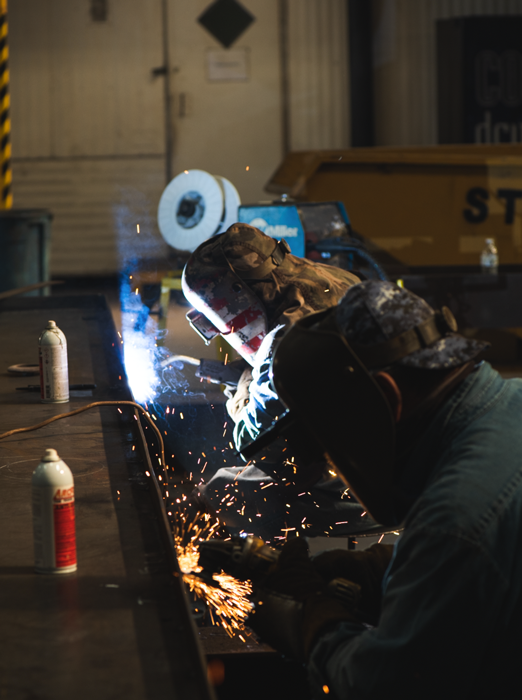
Choose the correct shielding gas
Your consumables have a big impact on how clean your weld runs. Pure CO2 is economical and gives deep penetration, but it tends to produce more spatter. Switching to an argon and CO2 blend, such as 75/25 or 90/10, creates a more stable arc and noticeably less spatter on carbon steel.
Wire quality matters as well. Inconsistent diameter, poor surface finish, or rusty, contaminated wire can all lead to an unstable arc. Store your wire in a dry place, keep it covered, and match the wire type to your base metal and gas. Using a quality wire that suits your application is often a small investment that pays off in less cleanup time.

Prep Your Material and Maintain Your Equipment
Dirty base metal is a hidden source of spatter. Mill scale, rust, oil, paint, and moisture all disturb the arc and cause the weld pool to pop and spit. Clean the joint area with a grinder, wire brush, or appropriate degreaser before welding.
Then take a look at your gun and consumables. Worn or clogged contact tips, damaged liners, and nozzles packed with built up spatter all lead to poor wire feeding and an inconsistent arc. Replace contact tips regularly, clear the nozzle, and make sure your gas flow is correct, typically 20 to 30 cubic feet per hour. Gas leaks, drafts or excessive spatter build-up in the nozzle can all effect weld performance. Keep your equipment clean and your gas and electrical connections tight. Poor grounds or loose connections of your leads can alter your power settings and reduce weld performance.

Use a Good Anti-Spatter Spray or nozzle gel
Even with great settings and clean prep, a little spatter is bound to happen. That’s where anti-spatter spray and nozzle gel come in. Applied to your nozzle, contact tip, and the surface around the joint, it keeps spatter from sticking, allowing it to be removed easily without a chisel or grinder.
Water-based formulas such as Washington Alloy’s Premium Water-Based Anti-Spatter Spray are a popular choice because they’re nonflammable, produce fewer fumes than solvent or petroleum-based products, and are typically silicone-free, which matters if the part will be painted, coated, or powder coated afterward. Apply a light, even coat and let it dry before welding, since too much product or a wet surface can introduce porosity into the weld. Reapply as needed, especially on longer production runs.

Bottom line: Consistency is key
Reducing spatter comes down to four things: the right settings, the right consumables, clean material with well maintained equipment, and a good antispatter spray. Make these part of your routine and you’ll spend less time grinding and more time welding, with better looking results.
Need quality welding wire, shielding gas, antispatter spray, or other consumables? Washington Alloy is here to help. Contact our team today and we’ll help you find the right products for your application.